
THE SHORT VERSION — Mostly no — and the “bloat” is misunderstood. The water creatine pulls in sits mainly inside your muscle cells, not under your skin, and it isn't harmful.[1] Any real stomach discomfort usually traces back to high-dose loading or poorly dissolved powder.[2]
Does creatine cause bloating?
For most guys, no — not the way they think. Creatine does pull water into your muscles, but that water sits inside the muscle cells, not under your skin.[1]
That intramuscular water is part of how creatine works, and it isn't harmful.[1] The puffy, “smooth” look guys worry about is mostly a myth carried over from old loading practices.
There are really two separate complaints hiding inside the word “bloating”: water weight on the scale, and an unsettled stomach after a serving. They have different causes and different fixes — this post covers both.
Where the bloating idea comes from
Two things: high-dose loading, and powder that won't dissolve.
Taking a big slug of creatine at once — especially monohydrate, which has low water solubility — can cause real stomach discomfort for some guys.[2][6] Barely-dissolved powder hitting your gut is the usual culprit, not the creatine itself.
The classic loading protocol from the 1990s — 20 grams a day for about a week — front-loads both problems at once: more total powder, bigger single servings, and a faster jump in water weight. That era is where creatine's bloating reputation was born, and it's stuck around long after loading stopped being necessary. (We cover whether loading is ever worth it in our loading phase guide.)
What's actually happening with the water weight?
Creatine is stored inside your muscle cells, and it draws water in with it — that's the mechanism working, not a side effect going wrong.[1]
Creatine is what physiologists call an osmolyte: where it goes, water follows. Since supplemental creatine is overwhelmingly taken up by skeletal muscle, the extra water ends up inside the muscle cell along with it.[1]
Researchers have measured this directly. In a controlled study of healthy men, about a month of creatine supplementation increased total body water — but the distribution of that water stayed normal, with no disproportionate shift to the space under the skin where visible puffiness shows up.[4] In other words: fuller muscles, not water under the skin.
How much scale weight should you expect?
Typically a couple of pounds in the first few weeks — faster if you load, slower and smaller if you take a low daily dose.
The size and speed of the jump tracks how fast you saturate your muscle stores. Classic loading research found that a high-dose week fills muscle stores in about six days, while a low 3-gram daily dose reaches the same saturation in about a month — same destination, gentler ramp.[5]
Two things worth keeping straight about that early weight:
- It isn't fat. A pound of water gained in week one has nothing to do with body fat — the calories in creatine are effectively zero.
- It levels off. Once your stores are saturated, the water gain is done. The scale isn't going to keep creeping up from creatine alone.[1]
If you'd rather skip the jump entirely, skip the loading phase. You give up a few weeks of faster ramp-up and nothing else.[3]
Bloating vs. stomach upset — two different complaints
Water weight is invisible and harmless. Stomach upset is real, dose-dependent, and fixable.
When researchers looked at gastrointestinal side effects directly, the pattern was clear: a single large 10-gram dose produced significantly more GI complaints than the same daily total split into smaller servings.[6] The stomach issue isn't creatine per se — it's concentration. A big, gritty, half-dissolved serving sitting in your gut pulls water into the intestine, and that's what you feel.
That's also why the fix list below works: every item on it either shrinks the single dose or gets the powder fully into solution before it reaches your stomach.
How to minimize any discomfort
A few simple fixes handle it for almost everyone:
- Skip the loading phase — a steady daily dose avoids the big single servings.[3]
- Split your dose — if you do load, or run a higher dose, break it into 2–4 smaller servings across the day.[6]
- Dissolve it fully — more liquid, more mixing, or warm water.
- Take it with a meal — food slows everything down and buffers the concentration hitting your gut.
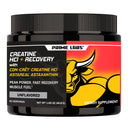
- Try HCl — far more soluble and taken in a smaller dose, which some stomachs prefer.[2] Prime Labs Creatine HCl+ and Creatine HCl + Astaxanthin Powder use ultra-soluble CON-CRĒT® creatine HCl — bloat-free and no loading required.* (Not sure which form fits you? See our breakdown of creatine types.)
Will creatine make you look puffy or fat?
No — if anything, saturated muscles look fuller, not softer.
Visible puffiness comes from water in the space under your skin. As covered above, measured fluid distribution on creatine stays in normal proportion — the added water is riding inside the muscle you're trying to grow.[1][4]
This is also why dropping creatine before a beach trip or a weigh-in mostly backfires: you give up strength output and muscle fullness to lose a small amount of water nobody can see. If you're cutting, the standard advice is to keep taking it — creatine supports the training intensity that protects lean mass while you diet.*[1]
Is the water weight harmful?
No. The water creatine stores in muscle is normal and not a health concern in healthy men.[1]
If anything, well-hydrated muscle cells are part of the point. Creatine has not been shown to adversely affect kidney function in healthy adults.[1]
Do you need to cycle off creatine?
There's no evidence you need to. Creatine isn't a hormone and doesn't down-regulate anything that needs a reset.
Long-term studies tracked in the ISSN's position stand — including multi-year use at doses well above the standard 5 grams — haven't shown harm in healthy adults, and cycling off simply lets your stores drain back down over a few weeks.[1][3] If you stop, nothing bad happens; you just slowly lose the saturation you built. The “cycle it like a hormone” advice is another carryover myth.
The bottom line
Creatine's “bloat” is mostly water stored where you want it — inside muscle — plus an occasional upset stomach that's entirely dose- and mixing-dependent.
Expect a couple pounds of scale weight as your stores saturate, then a plateau. If your stomach complains, split the dose, dissolve it fully, take it with food, or switch to an HCl form. And if you want the deeper timeline of what creatine does week by week, read how long creatine takes to work.