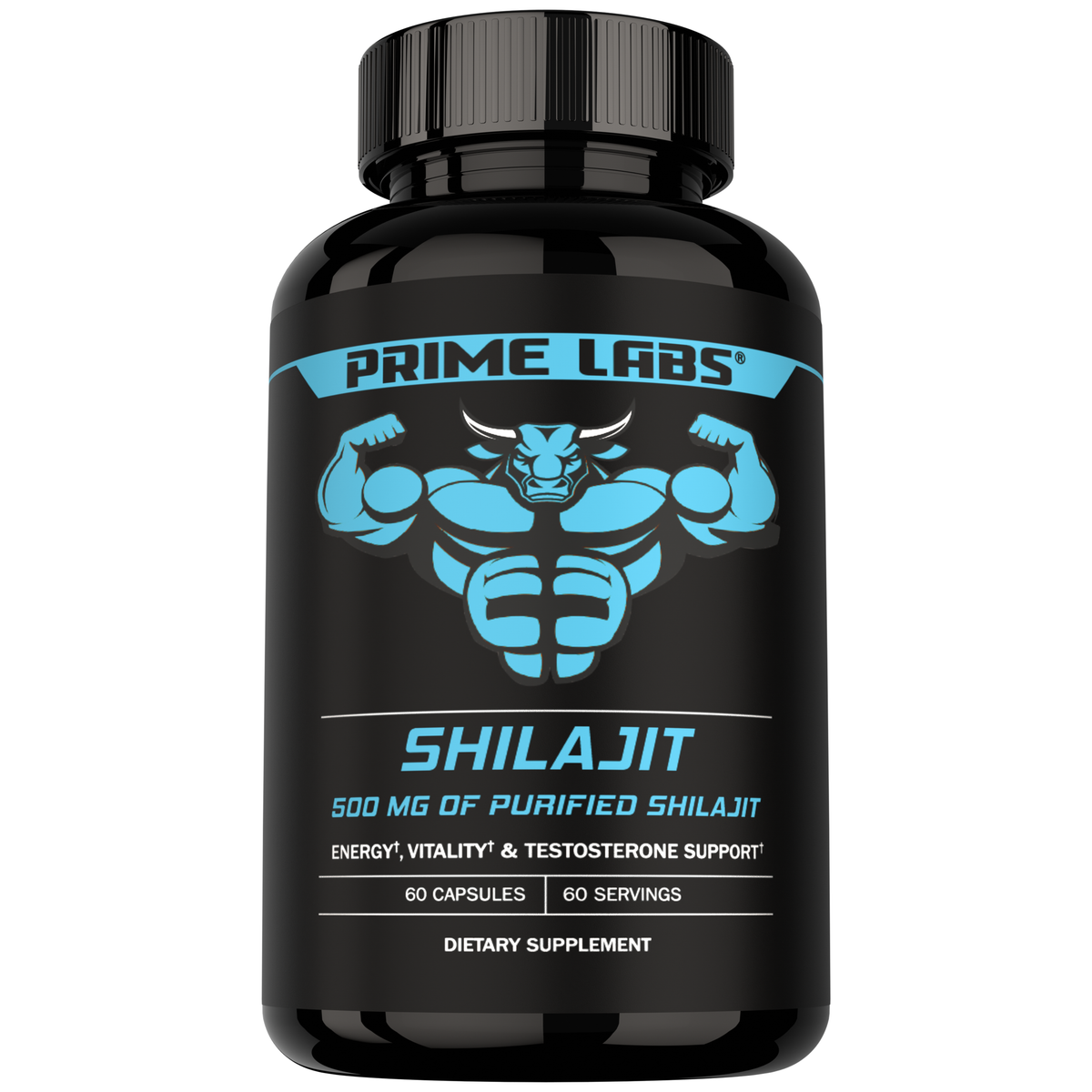
THE SHORT VERSION: The best shilajit is purified, tested, and honestly labeled. Where it comes from matters less than what's been removed from it. Home tricks like the flame or water test can't detect heavy metals. Only a lab can. Prime Labs Shilajit gives you 500 mg of purified Himalayan shilajit, standardized to 20% fulvic acid, third-party tested, and with no proprietary blend.
Shilajit is one of the easiest supplements to get wrong. It's a raw mineral pitch that comes out of the ground carrying whatever the rock contains, and the market is full of products that are hard to verify. We make a shilajit supplement, so we've spent a lot of time on this question. Here are the six markers we use to judge any shilajit, ours included.
What Makes a Shilajit Supplement "the Best"?
Purity, proof, and an honest label. The best shilajit supplement is purified to remove contaminants, verified by an outside lab, and dosed at the amount used in research. Exotic sourcing stories don't make that list.
That order matters. Shilajit's composition varies a lot depending on where and how it's collected.[1] The raw material can also contain heavy metals such as lead, arsenic, cadmium, and mercury.[2] Two jars both labeled "Himalayan shilajit" can be completely different products. Some aren't shilajit at all, because adulterated and counterfeit versions are sold under the name.[3]
The FDA doesn't approve supplements for safety or effectiveness before they're sold. Quality is the manufacturer's responsibility.[4] So the only way to choose well is to know which markers actually signal quality, and which are marketing. Here are the six that matter.
Marker 1: Is It Purified or Raw?
Choose purified. Raw shilajit is collected and sold with minimal processing, so whatever came out of the rock ends up in the jar.
Purification is a multi-step process of dissolving, filtering, and concentrating that separates the useful fraction from insoluble debris and helps lower contaminant levels. A safety review of shilajit specifically recommends standardized, processed preparations over raw material.[3] Every human trial we cover in this hub used a purified extract, not raw pitch.[5][6][7]
Look for: the word "purified" on the label, plus a description of how it's processed.
Be skeptical of: "raw," "unprocessed," or "straight from the mountain" presented as selling points.
Prime Labs Shilajit is purified Himalayan shilajit, sourced from high-altitude mineral deposits and put through multi-stage purification before it's encapsulated.
Marker 2: Has It Been Tested for Heavy Metals?
This is the one to take most seriously. Shilajit is a mineral substance, and without lab testing you can't know whether a batch carries heavy metals.[2]
The risk is documented. When researchers bought Ayurvedic products online and tested them, about one in five contained detectable lead, mercury, or arsenic.[8] A 2025 study of shilajit specifically detected thallium in both raw samples and finished supplements. Some supplements had higher levels than the raw material, and the authors called for routine, standardized testing.[9]
Look for: third-party testing, meaning an outside lab and not just the manufacturer's own claim.
Ask for: the certificate of analysis (COA), a lab report showing what a batch was tested for and the results. A reputable brand should be able to share one.
Be skeptical of: vague lines like "lab verified" with no detail. NIH notes that words like "verified" or "certified" don't guarantee quality on their own.[10]
Prime Labs Shilajit is third-party tested.
Marker 3: Does the Label State a Fulvic Acid Standardization?
It should. Fulvic acid is the organic compound that makes up most of shilajit's active fraction, and a stated percentage tells you the product was measured, not guessed.
Here's the nuance. Processed shilajit in the research literature typically runs 50–60% fulvic acids.[3] The branded extract used in the clinical trials was standardized to at least 50%.[6] Many finished products state lower numbers, and labels rarely explain the testing method, so a percentage on one label isn't always comparable to another. A stated standardization is a quality signal. A bigger number alone doesn't prove a better product.
Look for: a specific fulvic acid percentage on the Supplement Facts panel.
Be skeptical of: no standardization at all, or eye-popping percentages with no testing behind them.
Prime Labs Shilajit is standardized to 20% fulvic acid, and we print that number on the label.
Marker 4: Is the Dose Disclosed and Research-Aligned?
You should see one clear number per serving, and it should line up with the research. In human studies, that's 500 mg a day.
The key human trials used 250 mg twice daily or 500 mg once daily.[5][6][7] Short-term use at up to 500 mg a day is considered possibly safe.[2] Anything far outside that range, or hidden inside a proprietary blend, leaves you guessing how much shilajit you're actually getting.
Look for: a single disclosed milligram amount of shilajit per serving.
The approach we don't recommend: proprietary blends. A blend lists a total weight for several ingredients without saying how much of each is inside. You can't match that to a study dose.
Prime Labs Shilajit is one ingredient, 500 mg per capsule, no blend.
Marker 5: Is the Form Easy to Dose Accurately?
Capsules win on accuracy. Resin can be just as real, but dosing a sticky paste by eye makes it hard to hit a consistent amount.
A "pea-sized" portion of resin varies with the scoop, the temperature, and how dense the batch is. A capsule delivers the same 500 mg every day. That matters because the research effects came from consistent daily use over 8 to 12 weeks.[5][6] We go deeper on this in Shilajit Resin vs Capsules: Which Form Is Right for You.
Marker 6: Does the Brand Stay Honest About the Evidence?
Trust the brand that tells you what shilajit can't do. Shilajit's human research is real but small, and a trustworthy label reflects that.
A few controlled trials support specific structure/function benefits: healthy testosterone within the normal range, strength retention under fatigue, and connective-tissue support.*[5][6] Much of what's promised online beyond that rests mainly on animal studies. Only a few small human studies exist, and some were industry-funded.[2] When a brand leads with "clinically proven," "miracle," or a disease it claims to fix, that's a red flag about the whole operation.
A related trap is borrowing research. The key trials used one branded extract. We explain what that means for any product, ours included, in PrimaVie Shilajit: What "Clinically Studied" Actually Means.
Can You Tell If Shilajit Is Real at Home?
Not reliably. Popular home tests may tell you something about texture, but none of them can detect heavy metals or confirm what's actually in the jar.
The flame test: real resin supposedly bubbles and won't burn. Plenty of other sticky substances behave the same way.
The water test: real shilajit dissolves and turns the water golden-brown. Many dark, water-soluble materials do that too.
The stretch test: warm resin gets gooey and cold resin snaps. That tells you about temperature, not purity.
Only lab testing can tell you what's in a batch.[2] Skip the kitchen chemistry and check the brand's testing instead.
What Red Flags Should Make You Walk Away?
Walk away from any shilajit that can't answer basic quality questions. The biggest warning signs:
No purification claim. "Raw" isn't a feature for a mineral pitch.
No mention of testing, or a refusal to share results.
No stated dose or standardization. Just "shilajit" and a jar weight.
Disease or miracle claims. Supplements can't legally claim to treat conditions. A brand willing to break that rule deserves a hard look everywhere else.
"Natural" as the whole pitch. Natural doesn't mean safe.[10]